In informatics, meaning is achieved when described data is bound to a unique identifier of a data object.
The assertion that "Claude Funston’s height is five feet eleven inches," comes pretty close to being a meaningful statement. The
statement contains data (five feet eleven inches), and the data is described (height). The described data belongs
to a unique object (Claude Funston). Ideally, the name "Claude Funston" should be provided with a unique
identifier, to distinguish one instance of Claude Funston from all the other persons who are named Claude
Funston. The statement would also benefit from a formal system that ensures that the metadata makes sense
(eg, What exactly is height, and does Claude Funston fall into a class of objects for which height is a property?)
and that the data is appropriate (eg, Is 5 feet 11 inches an allowable measure of a person’s height?). A statement
with meaning does not need to be a true statement (eg, The height of Claude Funston was not 5 feet 11 inches
when Claude Funston was an infant).
© 2016 Jules Berman
key words: meaning, semantics, assertion, triple, rdf, metadata, identifier, identification, jules j berman
Showing posts with label metadata. Show all posts
Showing posts with label metadata. Show all posts
Friday, January 15, 2016
Wednesday, September 17, 2014
Three neglected principles of Big Data: identifiers, immutability, and introspection
My book, Principles of Big Data: Preparing, Sharing, and Analyzing Complex Information was published last year by Morgan Kaufmann.

There are three crucial topics related to data preparation that are omitted from virtually every other Big Data book: identifiers, immutability, and introspection.
A thoughtful identifier system ensures that all of the data related to a particular data object will be attached to the correct object, through its identifier, and to no other object. It seems simple, and it is, but many Big Data resources assign identifiers promiscuously, with the end result that information related to a unique object is scattered throughout the resource, attached to other objects, and cannot be sensibly retrieved when needed. The concept of object identification is of such overriding importance that a Big Data resource can be usefully envisioned as a collection of unique identifiers to which complex data is attached. Data identifiers are discussed in Chapter 2.
Immutability is the principle that data collected in a Big Data resource is permanent, and can never be modified. At first thought, it would seem that immutability is a ridiculous and impossible constraint. In the real world, mistakes are made, information changes, and the methods for describing information changes. This is all true, but the astute Big Data manager knows how to accrue information into data objects without changing the pre-existing data. Methods for achieving this seemingly impossible trick is described in detail in Chapter 6.
Introspection is a term borrowed from object oriented programming, not often found in the Big Data literature. It refers to the ability of data objects to describe themselves when interrogated. With introspection, users of a Big Data resource can quickly determine the content of data objects and the hierarchical organization of data objects within the Big Data resource. Introspection allows users to see the types of data relationships that can be analyzed within the resource and clarifies how disparate resources can interact with one another. Introspection will be described in detail in Chapter 4.
I urge you to read more about my book. Google books has prepared a generous preview of the book contents. If you like the book, please request your librarian to purchase a copy of this book for your library or reading room.
Jules J. Berman, Ph.D., M.D.tags: big data, metadata, data preparation, data analytics, data repurposing, datamining, data mining
There are three crucial topics related to data preparation that are omitted from virtually every other Big Data book: identifiers, immutability, and introspection.
A thoughtful identifier system ensures that all of the data related to a particular data object will be attached to the correct object, through its identifier, and to no other object. It seems simple, and it is, but many Big Data resources assign identifiers promiscuously, with the end result that information related to a unique object is scattered throughout the resource, attached to other objects, and cannot be sensibly retrieved when needed. The concept of object identification is of such overriding importance that a Big Data resource can be usefully envisioned as a collection of unique identifiers to which complex data is attached. Data identifiers are discussed in Chapter 2.
Immutability is the principle that data collected in a Big Data resource is permanent, and can never be modified. At first thought, it would seem that immutability is a ridiculous and impossible constraint. In the real world, mistakes are made, information changes, and the methods for describing information changes. This is all true, but the astute Big Data manager knows how to accrue information into data objects without changing the pre-existing data. Methods for achieving this seemingly impossible trick is described in detail in Chapter 6.
Introspection is a term borrowed from object oriented programming, not often found in the Big Data literature. It refers to the ability of data objects to describe themselves when interrogated. With introspection, users of a Big Data resource can quickly determine the content of data objects and the hierarchical organization of data objects within the Big Data resource. Introspection allows users to see the types of data relationships that can be analyzed within the resource and clarifies how disparate resources can interact with one another. Introspection will be described in detail in Chapter 4.
I urge you to read more about my book. Google books has prepared a generous preview of the book contents. If you like the book, please request your librarian to purchase a copy of this book for your library or reading room.
Jules J. Berman, Ph.D., M.D.tags: big data, metadata, data preparation, data analytics, data repurposing, datamining, data mining


Tuesday, March 4, 2008
Medical Linguistics, Part 5
The past few blogs have been a series devoted to Medical Linguistics. Yesterday's blog discussed the fundamental linguistic principles underlying the doublet method.
In today's blog, I'm posting a Perl script that extracts, from a large nomenclature, the terms that cannot be composed from doublets contained in other terms (i.e., the terms that must include unique doublets).
The key lines in the script are (that create the list of doublets) are shown here:
These lines are used in virtually every Perl script that uses the doublet method. Basically, they move through an array consisting of the consecutive words in a nomenclature term, two words at a time, creating a new doublet and a new member of a doublet hash structure, with each loop. If you know Perl, this little piece of code should be easy to understand.
The entire Perl script follows here. As with all my posted scripts, the software is provided "as is", without warranty of any kind, express or implied, including but not limited to the warranties of merchantability, fitness for a particular purpose and noninfringement. in no event shall the authors or copyright holders be liable for any claim, damages or other liability, whether in an action of contract, tort or otherwise, arising from, out of or in connection with the software or the use or other dealings in the software.
The output consists of a file composed of a list of terms, one line per term, that cannot be constructed from doublets found in other terms. This output was discussed in a prior blog. A sample list of doublets is available for download.
- Jules Berman
My book, Principles of Big Data: Preparing, Sharing, and Analyzing Complex Information was published in 2013 by Morgan Kaufmann.
I urge you to read more about my book. Google books has prepared a generous preview of the book contents. If you like the book, please request your librarian to purchase a copy of this book for your library or reading room.
tags: big data, metadata, data preparation, data analytics, data repurposing, datamining, data mining, doublet method, medical linguistics, medical algorithm, nomenclature
In today's blog, I'm posting a Perl script that extracts, from a large nomenclature, the terms that cannot be composed from doublets contained in other terms (i.e., the terms that must include unique doublets).
The key lines in the script are (that create the list of doublets) are shown here:
    foreach $thing (@words)
      {
      $doublet = "$oldthing $thing";
      if ($doublet =~ /^[a-z]+ [a-z]+$/)
        {
        $doublethash{$doublet} =
             $doublethash{$doublet} + 1;
        }
      $oldthing = $thing;
      }
These lines are used in virtually every Perl script that uses the doublet method. Basically, they move through an array consisting of the consecutive words in a nomenclature term, two words at a time, creating a new doublet and a new member of a doublet hash structure, with each loop. If you know Perl, this little piece of code should be easy to understand.
The entire Perl script follows here. As with all my posted scripts, the software is provided "as is", without warranty of any kind, express or implied, including but not limited to the warranties of merchantability, fitness for a particular purpose and noninfringement. in no event shall the authors or copyright holders be liable for any claim, damages or other liability, whether in an action of contract, tort or otherwise, arising from, out of or in connection with the software or the use or other dealings in the software.
#!/usr/local/bin/perl
open(TEXT,"neocl.xml")||die"cannot";
open(OUT,">dubuniq.txt")||die"cannot";
$line = " ";
while ($line ne "")
    {
    $line = <TEXT>;
    next if ($line !~ /\"(C[0-9]{7})\"/);
    next if ($line !~ /\"\> ?(.+) ?\<\//);
    $line =~ /\"\> ?(.+) ?\<\//;
    $phrase = $1;
    @words = split(/ /, $phrase);
    foreach $thing (@words)
      {
      $doublet = "$oldthing $thing";
      if ($doublet =~ /^[a-z]+ [a-z]+$/)
        {
        $doublethash{$doublet} =
             $doublethash{$doublet} + 1;
        }
      $oldthing = $thing;
      }
   }
close TEXT;
open(TEXT,"neocl.xml")||die"cannot";
$phrase = "";
$line = " ";
$count = 0;
while ($line ne "")
    {
    $oldthing = "";
    $rightflank = "";
    $leftflank = "";
    $line = <TEXT>;
    next if ($line !~ /\"(C[0-9]{7})\"/);
    next if ($line =~ /\"C0000000\"/);
    next if ($line =~ /\"C0000001\"/);
    next if ($line !~ /\"\> ?(.+) ?\<\//);
    $line =~ /\"\> ?(.+) ?\<\//;
    $phrase = $1;
    @words = split(/ /, $phrase);
    next if (scalar(@words) < 3);
    foreach $thing (@words)
      {
      $newdoublet = "$oldthing $thing";
      if ($newdoublet =~ /^[a-z]+ [a-z]+$/)
        {
        if (exists($doublethash{$newdoublet}))
           {
           if ($doublethash{$newdoublet} == 1)
             {
             if ($phrase =~ /[a-z]+ $oldthing/)
               {
               $leftflank = $&;
               }
             if ($phrase =~ /$thing [a-z]+/)
               {
               $rightflank = $&;
               }
             unless ($doublethash{$leftflank} > 1
                 && $doublethash{$rightflank} > 1)
               {
               $uniqphrase{$phrase} = "";
               }
             }
           }
        }
      $oldthing = $thing;
      }
    }

while ((my $key, my $value) = each(%uniqphrase))
   {
   $count++;
   print OUT "$count $key\n";
   }
exit;
The output consists of a file composed of a list of terms, one line per term, that cannot be constructed from doublets found in other terms. This output was discussed in a prior blog. A sample list of doublets is available for download.
- Jules Berman
My book, Principles of Big Data: Preparing, Sharing, and Analyzing Complex Information was published in 2013 by Morgan Kaufmann.
I urge you to read more about my book. Google books has prepared a generous preview of the book contents. If you like the book, please request your librarian to purchase a copy of this book for your library or reading room.
tags: big data, metadata, data preparation, data analytics, data repurposing, datamining, data mining, doublet method, medical linguistics, medical algorithm, nomenclature
Wednesday, April 4, 2007
Expressing triples in RDF
In yesterday's post, we discussed assertions composed of "triples". The "triples" that form the basis of RDF statements are: Specified subject then metadata then data.
Example: “Jules Berman” “blood glucose level” “85”
Jules Berman (subject)
blood glucose level (metadata or data describing the data that follows)
85 (the data)
There is a specific syntax for expressing triples in RDF. Let us create an RDF triple whose subject is the jpeg image file specified as:
http://www.gwmoore.org/ldip/ldip2103.jpg (subject)
dc:title (metadata)
and
"Normal Lung" (data)
In RDF syntax:
< rdf:Description
rdf:about="http://www.gwmoore.org/ldip/ldip2103.jpg" >
< dc:title > Normal Lung< /dc:title >
< /rdf:Description >
An example of three triples is proper RDF syntax is:
< rdf:Description
rdf:about="http://www.gwmoore.org/ldip/ldip2103.jpg" >
< dc:title > Normal Lung< /dc:title >
< /rdf:Description >
< rdf:Description
rdf:about="http://www.gwmoore.org/ldip/ldip2103.jpg" >
< dc:creator > Bill Moore< /dc:creator >
< /rdf:Description >
< rdf:Description
rdf:about="http://www.gwmoore.org/ldip/ldip2103.jpg" >
< dc:date > 2006-06-28< /dc:date >
< /rdf:Description >
RDF permits you to collapse multiple triples that apply to a single subject. The following RDF:Description statement is equivalent to the three prior triples:
< rdf:Description
rdf:about="http://www.gwmoore.org/ldip/ldip2103.jpg" >
< dc:title > Normal Lung< /dc:title >
< dc:creator > Bill Moore< /dc:creator >
< dc:date > 2006-06-28< /dc:date >
< /rdf:Description >
An example of a short but well-formed RDF image specification document is:
< ?xml version="1.0"? >
< rdf:RDF
xmlns:rdf="http://www.w3.org/1999/02/22-rdf-syntax-ns#"
xmlns:dc="http://purl.org/dc/elements/1.1/" >
< rdf:Description
rdf:about="http://www.gwmoore.org/ldip/ldip2103.jpg" >
< dc:title > Normal Lung< /dc:title >
< dc:creator > Bill Moore< /dc:creator >
< dc:date > 2006-06-28< /dc:date >
< /rdf:Description >
< /rdf:RDF >
The first line tells you that the document is XML. The second line tells you that the XML document is an RDF resource. The third and fourth lines are the namespace documents that are referenced within the document (more about this later). Following that is the RDF statement that we have already seen.
Believe it or not, this is 95% of what you need to know to specify your data with RDF. We will provide use-case examples in future blog posts.
-Jules Berman
Science is not a collection of facts. Science is what facts teach us; what we can learn about our universe, and ourselves, by deductive thinking. From observations of the night sky, made without the aid of telescopes, we can deduce that the universe is expanding, that the universe is not infinitely old, and why black holes exist. Without resorting to experimentation or mathematical analysis, we can deduce that gravity is a curvature in space-time, that the particles that compose light have no mass, that there is a theoretical limit to the number of different elements in the universe, and that the earth is billions of years old. Likewise, simple observations on animals tell us much about the migration of continents, the evolutionary relationships among classes of animals, why the nuclei of cells contain our genetic material, why certain animals are long-lived, why the gestation period of humans is 9 months, and why some diseases are rare and other diseases are common. In “Armchair Science”, the reader is confronted with 129 scientific mysteries, in cosmology, particle physics, chemistry, biology, and medicine. Beginning with simple observations, step-by-step analyses guide the reader toward solutions that are sometimes startling, and always entertaining. “Armchair Science” is written for general readers who are curious about science, and who want to sharpen their deductive skills.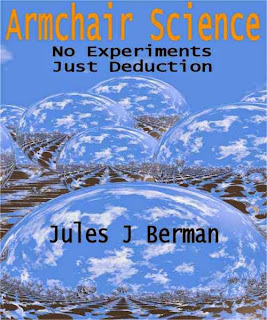
Example: “Jules Berman” “blood glucose level” “85”
Jules Berman (subject)
blood glucose level (metadata or data describing the data that follows)
85 (the data)
There is a specific syntax for expressing triples in RDF. Let us create an RDF triple whose subject is the jpeg image file specified as:
http://www.gwmoore.org/ldip/ldip2103.jpg (subject)
dc:title (metadata)
and
"Normal Lung" (data)
In RDF syntax:
< rdf:Description
rdf:about="http://www.gwmoore.org/ldip/ldip2103.jpg" >
< dc:title > Normal Lung< /dc:title >
< /rdf:Description >
An example of three triples is proper RDF syntax is:
< rdf:Description
rdf:about="http://www.gwmoore.org/ldip/ldip2103.jpg" >
< dc:title > Normal Lung< /dc:title >
< /rdf:Description >
< rdf:Description
rdf:about="http://www.gwmoore.org/ldip/ldip2103.jpg" >
< dc:creator > Bill Moore< /dc:creator >
< /rdf:Description >
< rdf:Description
rdf:about="http://www.gwmoore.org/ldip/ldip2103.jpg" >
< dc:date > 2006-06-28< /dc:date >
< /rdf:Description >
RDF permits you to collapse multiple triples that apply to a single subject. The following RDF:Description statement is equivalent to the three prior triples:
< rdf:Description
rdf:about="http://www.gwmoore.org/ldip/ldip2103.jpg" >
< dc:title > Normal Lung< /dc:title >
< dc:creator > Bill Moore< /dc:creator >
< dc:date > 2006-06-28< /dc:date >
< /rdf:Description >
An example of a short but well-formed RDF image specification document is:
< ?xml version="1.0"? >
< rdf:RDF
xmlns:rdf="http://www.w3.org/1999/02/22-rdf-syntax-ns#"
xmlns:dc="http://purl.org/dc/elements/1.1/" >
< rdf:Description
rdf:about="http://www.gwmoore.org/ldip/ldip2103.jpg" >
< dc:title > Normal Lung< /dc:title >
< dc:creator > Bill Moore< /dc:creator >
< dc:date > 2006-06-28< /dc:date >
< /rdf:Description >
< /rdf:RDF >
The first line tells you that the document is XML. The second line tells you that the XML document is an RDF resource. The third and fourth lines are the namespace documents that are referenced within the document (more about this later). Following that is the RDF statement that we have already seen.
Believe it or not, this is 95% of what you need to know to specify your data with RDF. We will provide use-case examples in future blog posts.
-Jules Berman
Science is not a collection of facts. Science is what facts teach us; what we can learn about our universe, and ourselves, by deductive thinking. From observations of the night sky, made without the aid of telescopes, we can deduce that the universe is expanding, that the universe is not infinitely old, and why black holes exist. Without resorting to experimentation or mathematical analysis, we can deduce that gravity is a curvature in space-time, that the particles that compose light have no mass, that there is a theoretical limit to the number of different elements in the universe, and that the earth is billions of years old. Likewise, simple observations on animals tell us much about the migration of continents, the evolutionary relationships among classes of animals, why the nuclei of cells contain our genetic material, why certain animals are long-lived, why the gestation period of humans is 9 months, and why some diseases are rare and other diseases are common. In “Armchair Science”, the reader is confronted with 129 scientific mysteries, in cosmology, particle physics, chemistry, biology, and medicine. Beginning with simple observations, step-by-step analyses guide the reader toward solutions that are sometimes startling, and always entertaining. “Armchair Science” is written for general readers who are curious about science, and who want to sharpen their deductive skills.
Thursday, March 29, 2007
Intro to RDF biomedical specifications
Many of us in the healthcare and life sciences spend a non-significant portion of our professional lives preparing data that will be entered into large databases.
Sometimes databases disappoint us. For a variety of reasons, we can never seem to merge our data with data produced by colleagues who have used a different database. Often, databases within a single institution are incompatible. The solution, we are told, is data standards. If we could mutually decide what data we need to store and how the stored data should be structured, then our databases would be compatible. Our trust in the wisdome of standards has fueled thousands of standards initiatives in the healthcare field.
The problem is that compliance with standards is often very low, and standards themselves can be flawed. As technologies change, standards do not always keep apace. This often results in obsolete standards or standards with multiple versions with idiosyncratic implementations.
RDF (Resource Description Framework) is a formal method for describing specified data objects with paired metadata and data and is prepared in XML syntax. In the next few blogs, I will try to show that RDF-specified data provides some of the functionality of standards. In addition, RDF-specifications greatly expand our ability to understand information. In my opinion, all life science professionals can benefit from understanding the basics of RDF.
-Jules Berman tags: biomedical, data standards, metadata, rdf, specifications
Science is not a collection of facts. Science is what facts teach us; what we can learn about our universe, and ourselves, by deductive thinking. From observations of the night sky, made without the aid of telescopes, we can deduce that the universe is expanding, that the universe is not infinitely old, and why black holes exist. Without resorting to experimentation or mathematical analysis, we can deduce that gravity is a curvature in space-time, that the particles that compose light have no mass, that there is a theoretical limit to the number of different elements in the universe, and that the earth is billions of years old. Likewise, simple observations on animals tell us much about the migration of continents, the evolutionary relationships among classes of animals, why the nuclei of cells contain our genetic material, why certain animals are long-lived, why the gestation period of humans is 9 months, and why some diseases are rare and other diseases are common. In “Armchair Science”, the reader is confronted with 129 scientific mysteries, in cosmology, particle physics, chemistry, biology, and medicine. Beginning with simple observations, step-by-step analyses guide the reader toward solutions that are sometimes startling, and always entertaining. “Armchair Science” is written for general readers who are curious about science, and who want to sharpen their deductive skills.
Sometimes databases disappoint us. For a variety of reasons, we can never seem to merge our data with data produced by colleagues who have used a different database. Often, databases within a single institution are incompatible. The solution, we are told, is data standards. If we could mutually decide what data we need to store and how the stored data should be structured, then our databases would be compatible. Our trust in the wisdome of standards has fueled thousands of standards initiatives in the healthcare field.
The problem is that compliance with standards is often very low, and standards themselves can be flawed. As technologies change, standards do not always keep apace. This often results in obsolete standards or standards with multiple versions with idiosyncratic implementations.
RDF (Resource Description Framework) is a formal method for describing specified data objects with paired metadata and data and is prepared in XML syntax. In the next few blogs, I will try to show that RDF-specified data provides some of the functionality of standards. In addition, RDF-specifications greatly expand our ability to understand information. In my opinion, all life science professionals can benefit from understanding the basics of RDF.
-Jules Berman tags: biomedical, data standards, metadata, rdf, specifications
Science is not a collection of facts. Science is what facts teach us; what we can learn about our universe, and ourselves, by deductive thinking. From observations of the night sky, made without the aid of telescopes, we can deduce that the universe is expanding, that the universe is not infinitely old, and why black holes exist. Without resorting to experimentation or mathematical analysis, we can deduce that gravity is a curvature in space-time, that the particles that compose light have no mass, that there is a theoretical limit to the number of different elements in the universe, and that the earth is billions of years old. Likewise, simple observations on animals tell us much about the migration of continents, the evolutionary relationships among classes of animals, why the nuclei of cells contain our genetic material, why certain animals are long-lived, why the gestation period of humans is 9 months, and why some diseases are rare and other diseases are common. In “Armchair Science”, the reader is confronted with 129 scientific mysteries, in cosmology, particle physics, chemistry, biology, and medicine. Beginning with simple observations, step-by-step analyses guide the reader toward solutions that are sometimes startling, and always entertaining. “Armchair Science” is written for general readers who are curious about science, and who want to sharpen their deductive skills.
Subscribe to:
Posts (Atom)