Yesterday's post took an example from DICOM to describe how the uses of an existing standard can be patented. A standard, even if it is a free and open standard, has little value if the intended uses of the standard are encumbered by patents. This would mean, in effect, that the user community must license the standard for uses that are covered by patents (or risk infringeing on one or more patents).
What can SDOs (Standards Development Organizations) do to prevent this problem? I am not a lawyer, and cannot give legal advice, but I would suggest that the following approach is sensible:
When the standard is being developed, the SDO should think about all the intended uses for the standard and publish a document (as an SDO white paper or as a journal publication) that describes, in detail, the ways that the standard can be used, supplying source code, instructions, sample implementations, user commentary, citations to relevant publications in the field, etc. This would help create prior art for the described uses of the patent. When the SDO provides public documentation for the common, expected uses of the standard, it would make it difficult for someone to come along and claim the those methods in a patent.
Also, SDOs should be prepared to work with their Patent Office to explain how patent applications related to their standard may be preceded by scientific art or may provide no new or non-obvious functionality to the standard. As described in an earlier post, the USPTO recognizes that software patents are a difficult area and has a program to seek guidance from the software community.
Suppose an inventor conceives of a totally new use of an existing standard and develops a patentable process or application for this new use. How would an SDO defend the standard in this case. Well, there might not be any defense. After all, if someone really comes up with a novel use for a standard that has a real-world application, why shouldn't their intellectual property be covered by a patent? The problem for SDOs comes from patents that cover customary, expected uses of a patent. SDOs with nothing in place to protect the basic uses of the standard have not done their job very well.
-Jules Berman
My book, Principles of Big Data: Preparing, Sharing, and Analyzing Complex Information was published in 2013 by Morgan Kaufmann.
I urge you to explore my book. Google books has prepared a generous preview of the book contents. If you like the book, please request your librarian to purchase a copy of this book for your library or reading room.
tags: big data, metadata, data preparation, data analytics, data repurposing, datamining, data mining
Devoted to the topic of data specification (including data organization, data description, data retrieval and data sharing) in the life sciences and in medicine.
Showing posts with label prior art. Show all posts
Saturday, March 10, 2007
Sunday, March 4, 2007
Protecting standards from embedded patents
In a prior blog, I discussed patent farming within standards. I promised another blog with suggestions for SDOs (Standard Development Organizations) that would reduce the risk that their standards were victimized by patent farming.
Here is the list:
1. Work closely with the USPTO (US Patent and Trade Office) or the EPO (European Patent Office) to block trivial or non-original patents applied to your standard. Take advantage of the USPTO peer to peer project.
2. Collect and publish a list of prior art for all the methods included in your standard
3. Where no prior art exists, develop and publish your own "prior" art as open source projects
4. Do your own careful patent search to ensure that your standard does not include any previously patented methods
5. Require your members to search their company's patents to ensure that they have no patents within the standard.
6. The patent searches conducted by companies that are members of the standards committee should include all patents transferred to patent holding
companies
7. Require members of the standards committee to sign agreements (co-signed by authorized representtives of their companies) that no company patents (held or transferred) or claims will apply to the standard.
8. Whenever possible, use open, or public domain, or old (> 20 years) methods within your standards.
9. Whenever possible, use "escape" methods in the standard so that users are not locked into a single method that implements the standard
10. Make optional standards, not required standards, so that the user community is not locked into one implementation
11. Make interoperable standards (that can port to-and-from related standards)
12. Make specifications, not standards (to be explained in a later blog - JB)
13. Have open [to the public] committee meetings and publish the minutes of your meetings
14. Include a "user advocate" in the standards committee
15. Publish the efforts you have made to comply with some or all of the suggestions in items 1 through 14.
16. As a user, whenever possible, use standards that were developed with most of the suggestions from this list. Remember, it is the user (not the SDO) that will pay for patents embedded within standards.
Nothing can reduce your risk to zero, but following these items can help. I will be writing future blogs that explain specific items from the list.
- Jules Berman
tags: embedded patents, european patent office, hidden patents, medical standards, patent farming, prior art, sdo, specifications, standards development organizations, trivial patents, uspto
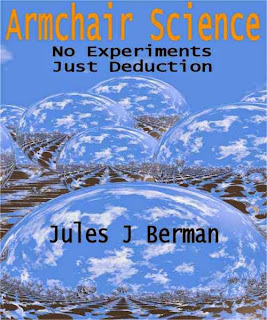
Science is not a collection of facts. Science is what facts teach us; what we can learn about our universe, and ourselves, by deductive thinking. From observations of the night sky, made without the aid of telescopes, we can deduce that the universe is expanding, that the universe is not infinitely old, and why black holes exist. Without resorting to experimentation or mathematical analysis, we can deduce that gravity is a curvature in space-time, that the particles that compose light have no mass, that there is a theoretical limit to the number of different elements in the universe, and that the earth is billions of years old. Likewise, simple observations on animals tell us much about the migration of continents, the evolutionary relationships among classes of animals, why the nuclei of cells contain our genetic material, why certain animals are long-lived, why the gestation period of humans is 9 months, and why some diseases are rare and other diseases are common. In “Armchair Science”, the reader is confronted with 129 scientific mysteries, in cosmology, particle physics, chemistry, biology, and medicine. Beginning with simple observations, step-by-step analyses guide the reader toward solutions that are sometimes startling, and always entertaining. “Armchair Science” is written for general readers who are curious about science, and who want to sharpen their deductive skills.
Here is the list:
1. Work closely with the USPTO (US Patent and Trade Office) or the EPO (European Patent Office) to block trivial or non-original patents applied to your standard. Take advantage of the USPTO peer to peer project.
2. Collect and publish a list of prior art for all the methods included in your standard
3. Where no prior art exists, develop and publish your own "prior" art as open source projects
4. Do your own careful patent search to ensure that your standard does not include any previously patented methods
5. Require your members to search their company's patents to ensure that they have no patents within the standard.
6. The patent searches conducted by companies that are members of the standards committee should include all patents transferred to patent holding
companies
7. Require members of the standards committee to sign agreements (co-signed by authorized representtives of their companies) that no company patents (held or transferred) or claims will apply to the standard.
8. Whenever possible, use open, or public domain, or old (> 20 years) methods within your standards.
9. Whenever possible, use "escape" methods in the standard so that users are not locked into a single method that implements the standard
10. Make optional standards, not required standards, so that the user community is not locked into one implementation
11. Make interoperable standards (that can port to-and-from related standards)
12. Make specifications, not standards (to be explained in a later blog - JB)
13. Have open [to the public] committee meetings and publish the minutes of your meetings
14. Include a "user advocate" in the standards committee
15. Publish the efforts you have made to comply with some or all of the suggestions in items 1 through 14.
16. As a user, whenever possible, use standards that were developed with most of the suggestions from this list. Remember, it is the user (not the SDO) that will pay for patents embedded within standards.
Nothing can reduce your risk to zero, but following these items can help. I will be writing future blogs that explain specific items from the list.
- Jules Berman
tags: embedded patents, european patent office, hidden patents, medical standards, patent farming, prior art, sdo, specifications, standards development organizations, trivial patents, uspto
Science is not a collection of facts. Science is what facts teach us; what we can learn about our universe, and ourselves, by deductive thinking. From observations of the night sky, made without the aid of telescopes, we can deduce that the universe is expanding, that the universe is not infinitely old, and why black holes exist. Without resorting to experimentation or mathematical analysis, we can deduce that gravity is a curvature in space-time, that the particles that compose light have no mass, that there is a theoretical limit to the number of different elements in the universe, and that the earth is billions of years old. Likewise, simple observations on animals tell us much about the migration of continents, the evolutionary relationships among classes of animals, why the nuclei of cells contain our genetic material, why certain animals are long-lived, why the gestation period of humans is 9 months, and why some diseases are rare and other diseases are common. In “Armchair Science”, the reader is confronted with 129 scientific mysteries, in cosmology, particle physics, chemistry, biology, and medicine. Beginning with simple observations, step-by-step analyses guide the reader toward solutions that are sometimes startling, and always entertaining. “Armchair Science” is written for general readers who are curious about science, and who want to sharpen their deductive skills.
Subscribe to:
Comments (Atom)