Showing posts with label open access. Show all posts

Thursday, August 14, 2008

Appeals Court Ruling on Open Source License

I thought I'd take a break from my series of blogs on Neoplasms to discuss this week's (August 13) important court ruling that upholds open source licenses. I'm referring to the following:

United States Court of Appeals for the Federal Circuit
2008-1001
ROBERT JACOBSEN,
Plaintiff-Appellant,
v.
MATTHEW KATZER and
KAMIND ASSOCIATES, INC. (doing business as KAM Industries),
Defendants-Appellees.
DECIDED: August 13, 2008

The entire ruling is available at:

http://www.cafc.uscourts.gov/opinions/08-1001.pdf

Today's blog post is a layman's interpretation of the issues involved and the significance of the court's ruling.

Basically, software code taken from an open source application was used in a patented product, without citing the open source software as prior art. The copyright holder sued. The patent holder did not dispute taking some of the open source code, but insisted that the open source license was unenforceable and that he was within his rights to use the code for whatever he pleased. The lower court agreed, essentially invalidating the open source license.

The appeals court overturned the lower court ruling and upheld the legal standing of the conditions specified in the open source license. This ruling permits additional legal recourse to be taken by the open source copyright holder against the patent holder, but for the open source community, the importance of the ruling is that it upholds the legal validity of the conditions specified in the open source document (mostly, these are the requirements that pertain to maintaining the open source license for uses and redistributions of the original software, so that the software remains open source and available, and credited to the original copyright holder).

Why do some people think that the open source license has no legal validity? Basically, there is a long tradition that licenses and contracts and virtually all types of signed agreements, exist for some mercantile purpose. Agreements specify who owes what to whom. Some say that a license that gives something away for free is just a joke. There is no need for the courts to get involved in silly requirements imposed on people who are exchanging items that have no monetary value.

The requirements in an open source software license are called "viral inclusions," if they impose conditions that are transmissible from one user to the next user. If I allow Fred to use my software under a set of conditions that requires him to convey the same conditions on Sally, the next person who uses the software, then in effect, I have created a license between myself and Sally (without ever exchanging money and without having a meeting of the minds, with Sally). Some have claimed that the so-called "viral" propagation of license conditions is a legal absurdity and cannot be enforced.

Well, the open source advocates have had their day in court, and they have won their argument. It basically goes like this. People who use the open source license are using a new kind of legal device that serves their own valid interests and the interests of society. In addition, the open source license was created by very thoughtful and talented legal minds and is supported by legitimate public and private concerns (as evidenced by Amicus briefs entered for the proceedings) who would suffer losses if open source licenses were invalidated (i.e., the open source license supports mercantile efforts and is not just a give-away for software that has no value).

If there is no money exchanged, who benefits from an open source license? When a copyright holder distributes software under an open source license, she receives credit for the accomplishment from the user community, thus enhancing her standing, and her marketability, and contributing to a community effort that encourages others to do the same (so she can likewise benefit from software produced by her colleagues). The license specifies a set of conditions that makes the communal use of software possible while preserving copyright with the original creator of the software. The open source license is written to enforce certain rights and intentions of the copyright holder that benefit the copyright holder. Furthermore, those who do not like the conditions imposed in the open source license, are asked to contact the copyright holder to negotiate an alternate software conveyance (i.e., the open source license suggests a way to seek an alternate legal device to obtain use of the same software). If the courts were to invalidate the conditions imposed within the open source license, then the copyright holder would be hurt, and the communal effort to create open source software would quickly collapse, much to the detriment of society.

The Appeals court, in its published statement, recognizes the purpose and the validity of the so-called viral conditions imposed by the open source license.

This is my [layman's] interpretation of the ruling. I urge everyone to go to the original document and draw their own conclusions.

-Copyright (C) 2008 Jules J. Berman


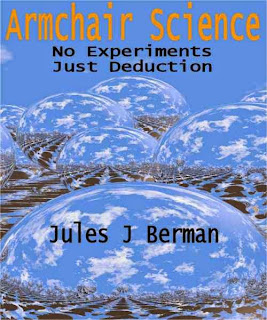
Science is not a collection of facts. Science is what facts teach us; what we can learn about our universe, and ourselves, by deductive thinking. From observations of the night sky, made without the aid of telescopes, we can deduce that the universe is expanding, that the universe is not infinitely old, and why black holes exist. Without resorting to experimentation or mathematical analysis, we can deduce that gravity is a curvature in space-time, that the particles that compose light have no mass, that there is a theoretical limit to the number of different elements in the universe, and that the earth is billions of years old. Likewise, simple observations on animals tell us much about the migration of continents, the evolutionary relationships among classes of animals, why the nuclei of cells contain our genetic material, why certain animals are long-lived, why the gestation period of humans is 9 months, and why some diseases are rare and other diseases are common. In “Armchair Science”, the reader is confronted with 129 scientific mysteries, in cosmology, particle physics, chemistry, biology, and medicine. Beginning with simple observations, step-by-step analyses guide the reader toward solutions that are sometimes startling, and always entertaining. “Armchair Science” is written for general readers who are curious about science, and who want to sharpen their deductive skills.
Wednesday, January 9, 2008

NIH-funded investigators must make their publications open access

As of Dec. 27, 2007, investigators funded by NIH must submit a copy of their accepted research articles to PubMed Central, for open access publication.

Excerpt from publication policy (inside the ominbus spending bill):

"The Director of the National Institutes of Health shall require that all investigators funded by the NIH submit or have submitted for them to the National Library of Medicine's PubMed Central an electronic version of their final, peer-reviewed manuscripts upon acceptance for publication to be made publicly available no later than 12 months after the official date of publication: Provided, That the NIH shall implement the public access policy in a manner consistent with copyright law."

In May 2005, a new open access policy at NIH asked NIH-funded investigators to submit their publications for open access publication, but the earlier policy was voluntary.

How did scientists respond? In Feb. 2006, the NIH released data showing that grantee compliance with NIH's open access policy was below 4%.

Now, cooperation is a legal requirement for U.S. funded investigators. Other countries have preceded the U.S. with similar policies. It seems only fair that taxpayers get to see what they've paid for.

Source:
BiomedCentral article


-Jules Berman tags: funding, investigators, nih, open access, public access, science
Science is not a collection of facts. Science is what facts teach us; what we can learn about our universe, and ourselves, by deductive thinking. From observations of the night sky, made without the aid of telescopes, we can deduce that the universe is expanding, that the universe is not infinitely old, and why black holes exist. Without resorting to experimentation or mathematical analysis, we can deduce that gravity is a curvature in space-time, that the particles that compose light have no mass, that there is a theoretical limit to the number of different elements in the universe, and that the earth is billions of years old. Likewise, simple observations on animals tell us much about the migration of continents, the evolutionary relationships among classes of animals, why the nuclei of cells contain our genetic material, why certain animals are long-lived, why the gestation period of humans is 9 months, and why some diseases are rare and other diseases are common. In “Armchair Science”, the reader is confronted with 129 scientific mysteries, in cosmology, particle physics, chemistry, biology, and medicine. Beginning with simple observations, step-by-step analyses guide the reader toward solutions that are sometimes startling, and always entertaining. “Armchair Science” is written for general readers who are curious about science, and who want to sharpen their deductive skills.

Friday, May 25, 2007

Consequences of open access to clinical trial data

There was a very interesting development that was reported earlier this week, by Barry Meier in the May 23 New York Times.

Dr. Steven Nissen, a cardiologist at the Cleveland Clinic, had visited the Glaxo Wellcome clinical trials site, which contains data on drug trials. Nissen made an observation, based on Glaxo Wellcome's own data, that shed new light on the risks of cardiac side-effects with Avandia.

Without going into any of the specifics of this particular finding, I would just like to comment that Glaxo Wellcome made a valuable contribution to medicine simply by opening its clinical trial data to public review.

Research reports are always misleading. This is not because the authors of research reports are liars (although I'm sure that lying sometimes occurs), but because it is human nature to describe research findings in a way that supports a self-serving view of reality. That is why the primary data upon which research findings are based must always be open for public review.

By releasing de-identified clinical data to the public, the data can be reviewed and analyzed to yield fresh insights. Yes, sometimes public review may yield faults in the study that were overlooked by the original authors. Sometimes public review may yield conclusions that the original authors would rather not entertain. My personal hope is that more often than not, review of the data will yield new opportunities, new discoveries and new hypotheses that will benefit everyone.... and that will particularly benefit the original creators of the data. Ultimately, review of public datasets will support integrative studies that combine speficied data from many different studies to produce important results that were unanticipated by any of the original data creators.

-Jules Berman
In June, 2014, my book, entitled Rare Diseases and Orphan Drugs: Keys to Understanding and Treating the Common Diseases was published by Elsevier. The book builds the argument that our best chance of curing the common diseases will come from studying and curing the rare diseases.


I urge you to read more about my book. There's a generous preview of the book at the Google Books site.

tags: common disease, orphan disease, orphan drugs, genetics of disease, disease genetics, rules of disease biology, rare disease, pathology, clinical trial, data integration, data review, open access, trialists

Friday, March 2, 2007

New version of neoplasm classification available

The latest version of the Developmental Lineage Classification and Taxonomy of Neoplasms is now available at:

NEOCLXML.GZ 716,963 bytes and
NEOSELF.GZ 1,086,677 bytes

Neoclxml.gz expands to over 10 Megabytes and is an XML file.
Neoself.gz expands to over 20 Megabytes and is a flat-file.

Each file contains over 145,000 neoplasm terms grouped in >6,000 concepts, and classified according to embryonic lineage. This is, by far, the most extensive nomenclature and classification of neoplasms in existence. It is copyrighted to Jules J. Berman and distributed under a GNU document license.

Detailed information on the classification is available in my article:
Tumor classification: molecular analysis meets Aristotle

tags: cancer, medical terminology, nomenclature, open access, open source
Science is not a collection of facts. Science is what facts teach us; what we can learn about our universe, and ourselves, by deductive thinking. From observations of the night sky, made without the aid of telescopes, we can deduce that the universe is expanding, that the universe is not infinitely old, and why black holes exist. Without resorting to experimentation or mathematical analysis, we can deduce that gravity is a curvature in space-time, that the particles that compose light have no mass, that there is a theoretical limit to the number of different elements in the universe, and that the earth is billions of years old. Likewise, simple observations on animals tell us much about the migration of continents, the evolutionary relationships among classes of animals, why the nuclei of cells contain our genetic material, why certain animals are long-lived, why the gestation period of humans is 9 months, and why some diseases are rare and other diseases are common. In “Armchair Science”, the reader is confronted with 129 scientific mysteries, in cosmology, particle physics, chemistry, biology, and medicine. Beginning with simple observations, step-by-step analyses guide the reader toward solutions that are sometimes startling, and always entertaining. “Armchair Science” is written for general readers who are curious about science, and who want to sharpen their deductive skills.